

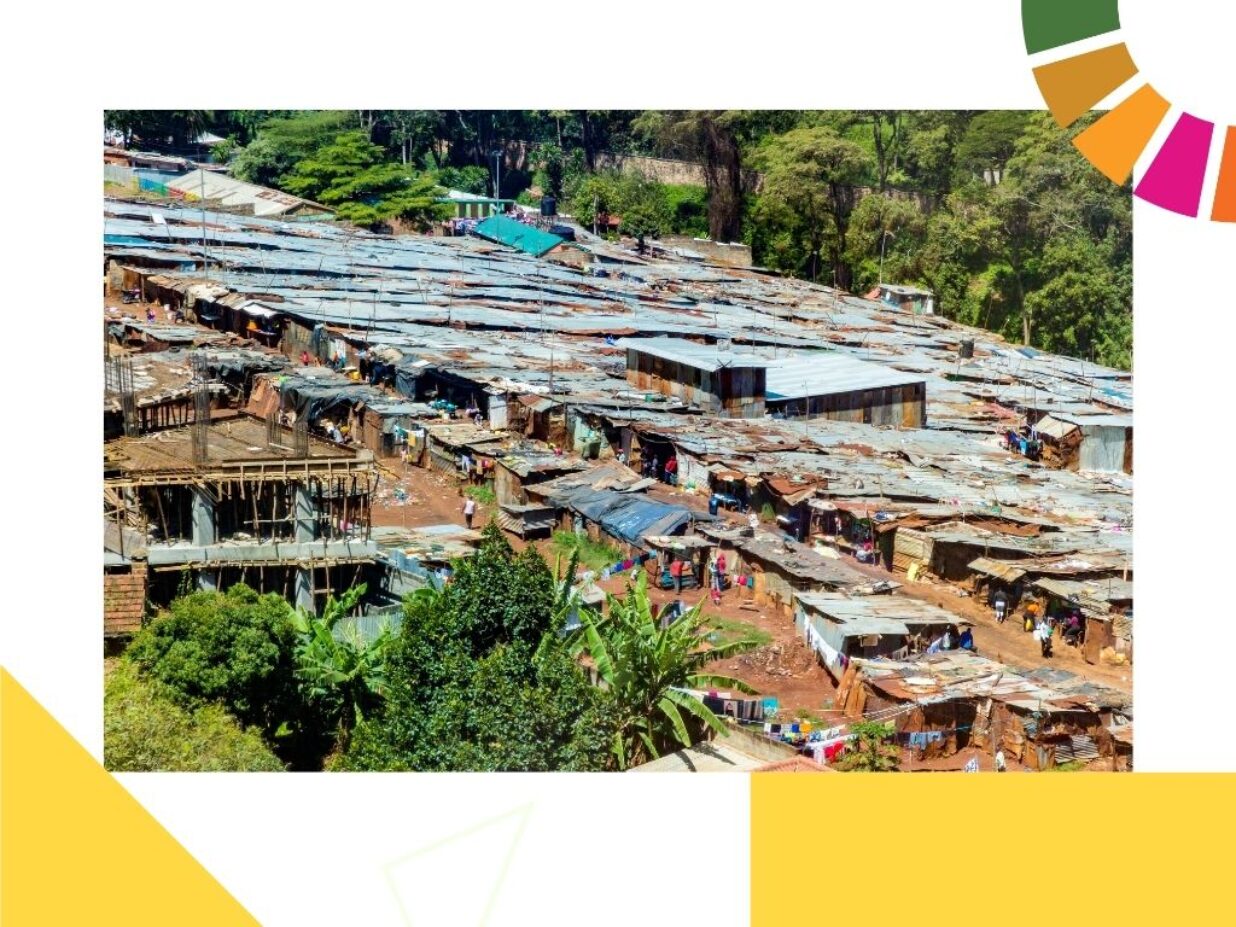
Today we will make children aware that slum areas exist in different parts of the world and will increase their knowledge of the greatest deficiencies and needs in areas of poverty.

MATERIALS
- presentation “Life in slums” from attachment 1
- story “We build safe houses”
Instruction
Ask the children to sit comfortably on the carpet. Tell them that in today’s classes you will talk about the poorest parts of cities, i.e. slums. Ask if any of the children has heard the word slums or favela. If not, using your own words describe what slums are. Use the definition below.
Slums
Slums constitute an area of the city inhabited by the poorest people. Slums are created by people coming to the cities (from the countryside or from other countries) who cannot afford to rent a flat within the urban area. They create makeshift houses made of planks, cloth or corrugated sheets, just to have a temporary shelter. However, this temporary place often becomes a home for a lifetime. People living in the slums often do not have access to clean water or electricity. You can forget about any sewage disposal! There are also no clearly pathed streets. In slums, nearly no one has access to water in their own house. You have to walk for a few, and sometimes even for several, minutes and bring it in a container often so heavy that you can only lift it by putting it on your head.
Then, show to the children the presentation “Life in slums” from attachment 1. You can add some information provided below, while showing individual photos:
- Currently, 900 million people live in slums. If we assume that our class represents all people on the globe, one person out of seven would live in the poorest area. This means that as many as X* of us would live in the poorest area of the city.
*Give a specific number, proportional to the number of children in your class. 2 people – if the class is small or 4 – if the class consists of as many as 28 children.
- Most of the poor districts are located in the poorest countries of Africa and Asia. However, slums can be found all around the world. Even in France, a rich European country, a slum area emerged in Paris (the capital city of France). The people who came to work in Paris could not afford to rent a flat in the city. They built makeshift huts — shelters made of planks and corrugated sheets, which were supposed to serve as temporary houses but remained their homes for many years.
- People living in slums often don’t have a full-time job. If they have a job, it is hard and low-paid. Most often they are employed as housekeepers, rag collectors, people segregating rubbish into paper, glass and plastic, roadside sellers, porters at construction sites and rickshaw drivers, i.e. taxi drivers (a rickshaw is a form of a taxi made out of a converted bicycle or scooter. The person driving the bike/scooter gives their clients a lift anywhere and gets paid a small fee).
- A single (small) room in slums is usually inhabited by 6 to 10 people.
- ⅓ of all the houses in slums do not have bathrooms. What is more, the ones existing are not connected to the sewage system.
- The lack of drinkable water is a huge challenge in slums. In the lines for clean water delivered in cisterns you sometimes have to wait for several hours.


Project is financed by European Union. This project is a part of global advocacy campaign of Habitat for Humanity aimed at improvement of access to land for a shelter.