

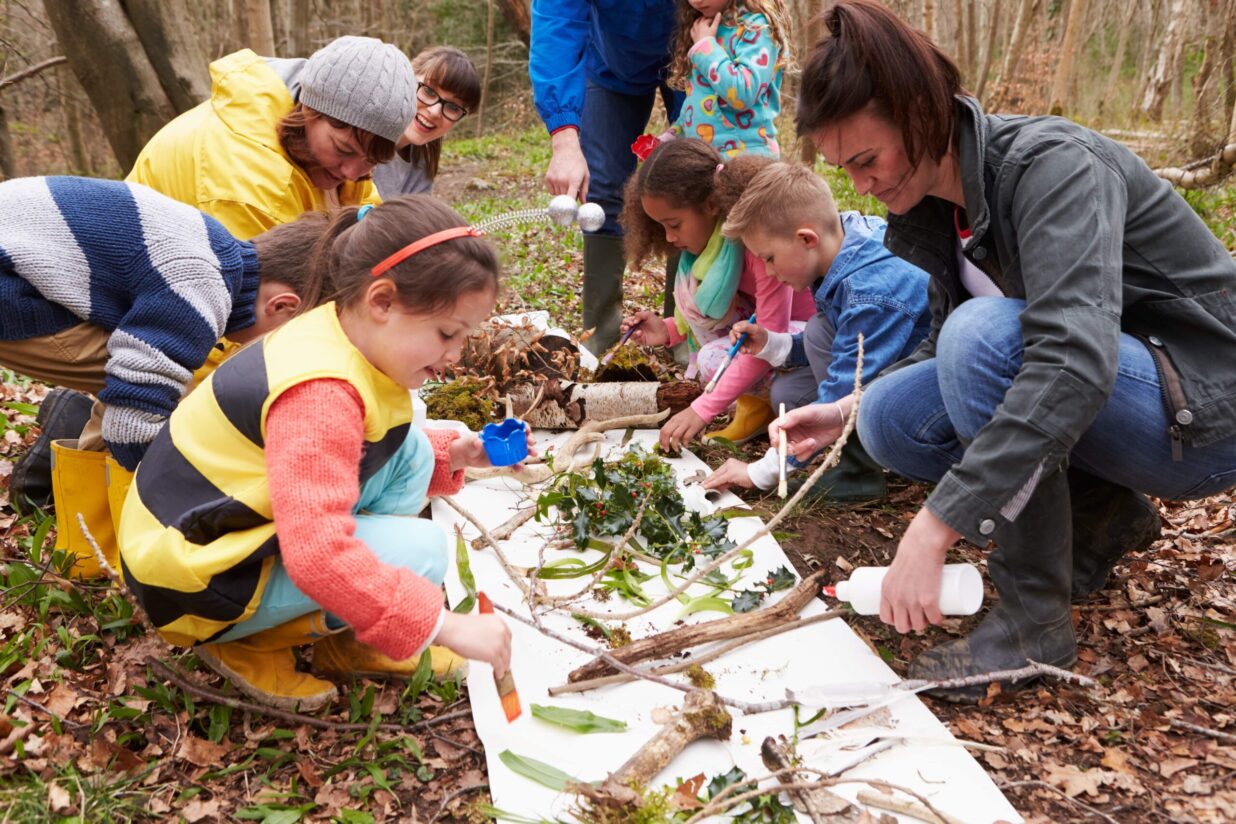
In today’s world, where many children spend more time looking at various screens, it’s worth pointing out activities that encourage them to get some fresh air and connect with nature. We suggest building a stork’s nest in the schoolyard with children.
Before beginning, it’s worth telling the kids a little about the storks’ behavior and how they build their nests. This will help them understand the aim of the activity.
Storks start building or renewing their nests shortly after returning from their wintering grounds. Over the years, the nests have reached impressive sizes. The width of such a nest varies between 90 and 200 cm, sometimes even exceeding 2 meters. The nest weighs 500 kg on average, in exceptional cases even 2 tons. The base of the nest is made of sticks and branches, the lining is made of dry grass and straw, and in recent years, unfortunately, also of rubbish—paper, cloths, and foil. Storks most often nest on electricity poles, building roofs, trees, and chimneys, and are also happy to use special man-made platforms. Examples of nests can be seen in the photos in the attachment (Attachment 4.1).
Aim:
– Spending time outside, developing creativity, and getting to know the fascinating world of storks
Time: 30 minutes

MATERIALS
Task Description
The children collect sticks, grasses, and other natural materials from the surroundings, just as storks do. It’s worth encouraging the kids to experiment with different nest shapes and sizes while learning which branches are more flexible and suitable for the structure. This is an ideal opportunity to teach teamwork and creative thinking. Children can work together, exchange ideas, and solve problems that they encounter during the task.


This post was produced as part of a project co-financed by the Deutsche Bundesstiftung Umwelt in cooperation with the Naturschutzzentrum Oberlausitzer Bergland.