

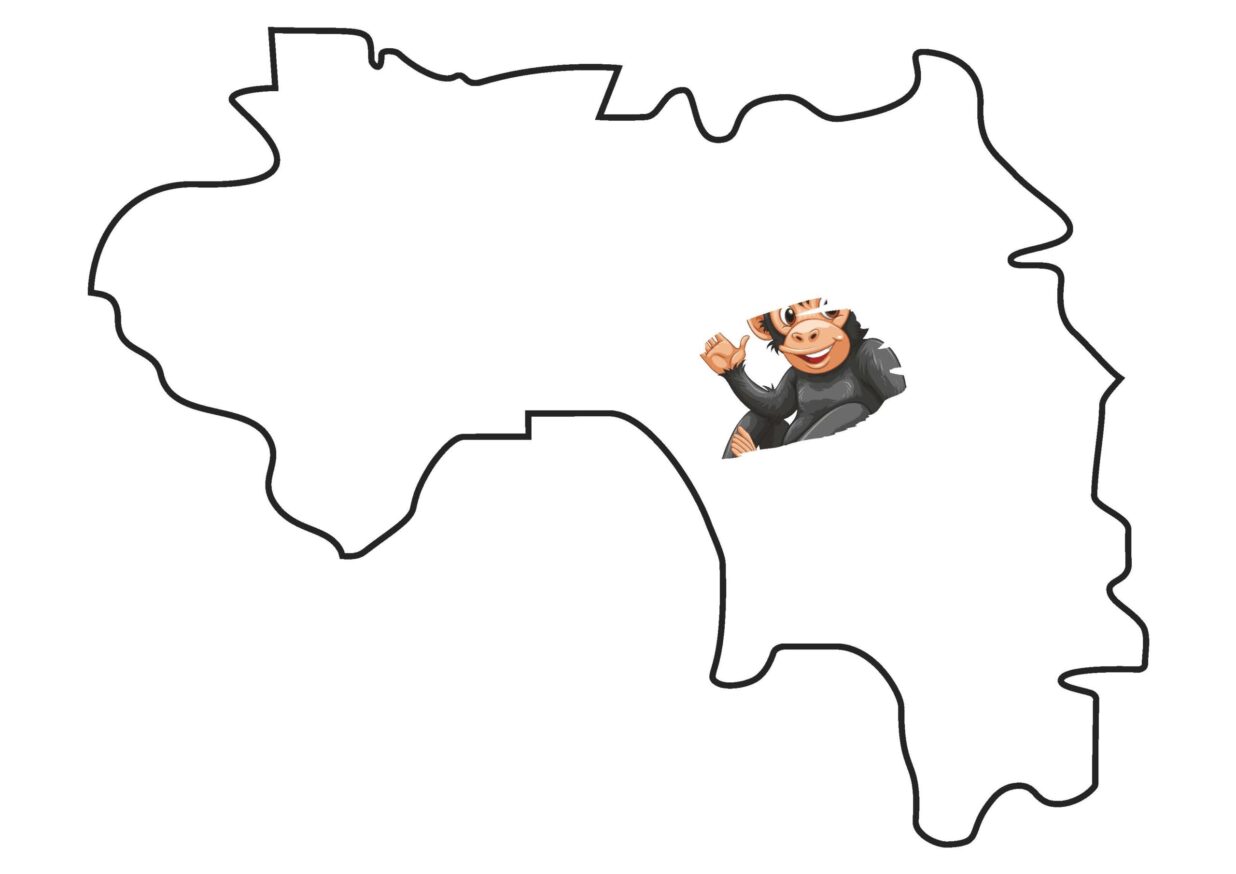
The central protected area of the Upper Niger National Park and the Nimba Mountains Strict Nature Reserve are two areas in Guinea, West Africa, where chimpanzees are protected. The chimpanzee rehabilitation project we want to support through Kids Save Animals III is based at the rehabilitation centre located in the Upper Niger National Park. Let’s learn more about Guinea’s wildlife and nature.
Objective: to introduce children to the natural habitat of common chimpanzees
Duration: 30 minutes

MATERIALS:
- map — attachment 2.1
- presentation — attachment 2.2
- white paper
- coloured pencils
Activity steps:

The teacher tells the children about the country where the chimpanzees we want to help live, using a large-format copy of attachment 2.1. Guinea is located in West Africa and is an incredibly rich region in terms of wildlife and nature. It has access to the ocean, and its landscapes include savannahs, forests, lowlands, highlands, and mountains. The country’s two largest rivers are the Niger and the Gambia. Its highest peak is Mount Nimba, standing at 1,700 m above sea level. The park where the chimpanzees we want to help are protected is situated on the Fouta Djallon highlands, within the Upper Niger National Park. (Its approximate location is marked on the attached map.)
Other wild animals found in Guinea include: hippos and crocodiles in the rivers; baboons and guenons in the forests; and buffalo, antelopes, cheetahs, and leopards on the savannahs. There is also an abundance of various birds, snakes, and spiders.
Let’s also take a look at Guinea’s plant life. The country features: dry forests, gallery forests, woodland savannah, shrubby savannah, grassland savannah, as well as areas used by humans. Chimpanzees can adapt to all of these environments. However, their survival is threatened by:
- Habitat destruction: Particularly intensive deforestation driven by the logging industry and extractive industries (oil and mining). Damaged forests are more exposed to wind and sun and are more vulnerable to fires.
- Disease: Habitat destruction leads to more frequent contact between humans and apes, making it easier for diseases to spread — diseases to which chimpanzees have no immunity, such as the Ebola virus.
- Hunting of chimpanzees.
Over the past 30 years, the wild chimpanzee population has declined by 66%. At the beginning of the 20th century, there were likely around 2 million chimpanzees; by about 1960, the number had dropped to just over 1 million. The most recent estimates put the population at between 172,000 and 301,000.
After hearing the story about Guinea’s wildlife, the children work together (or individually) to create a poster encouraging the protection of chimpanzees and their natural habitats. The map from attachment 2.1 can be used as a background.
NOTE: When displaying the slide with animals, you can ask the children which animals they already recognise.
Related
 TupTupTup content and resources are free and available to everyone — thank you for using them.
If you appreciate what we do, you can support TupTupTup with a donation or by allocating 1.5% of your tax. Simply enter KRS 0000270261 in your tax return, adding the specific purpose: Fundacja To Proste 18808.