

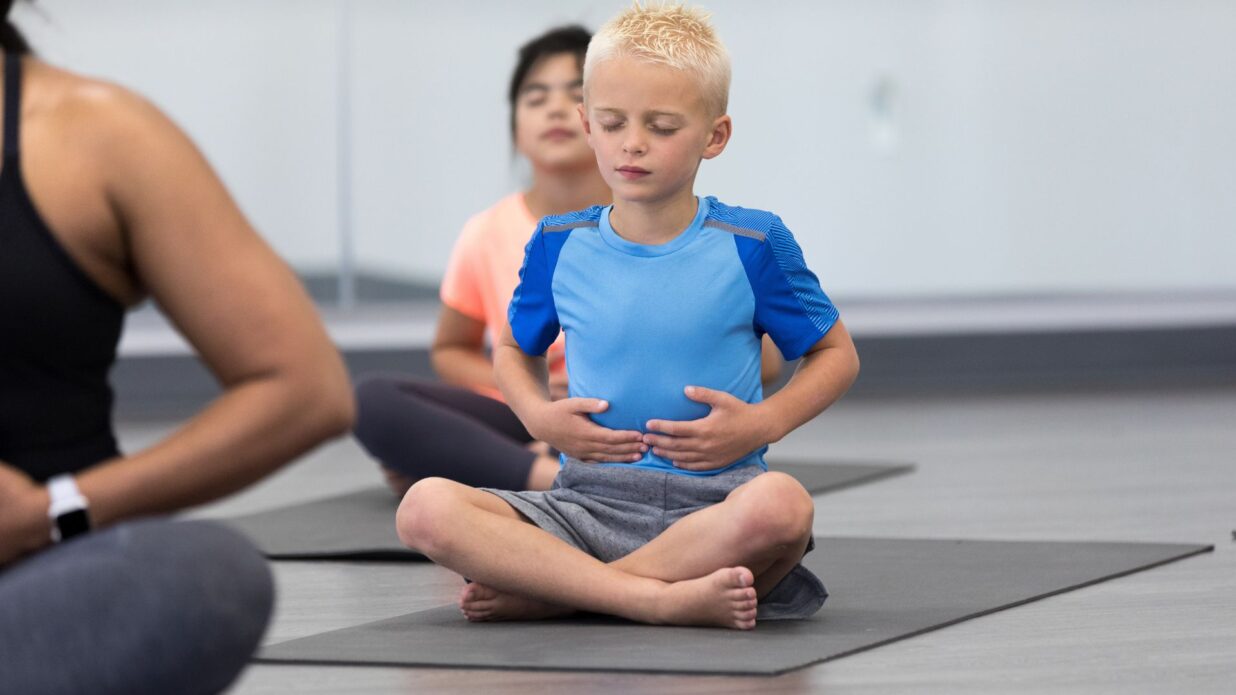
Breathing seems like the most natural thing in the world — and yet, for many children (and adults too), it’s often not quite right. Nose breathing for kids is one of the most overlooked aspects of their health, even though it affects everything from sleep to focus to immunity. The nose acts as the body’s built-in air filter: it cleans, warms, and moistens the air before it reaches the lungs, which means better oxygenation and a stronger defense against infections. Healthy breathing is quiet and calm — the mouth stays gently closed, and the breath doesn’t draw any attention to itself.
The key player in healthy breathing is the diaphragm. On the inhale, the belly gently rises; on the exhale, it falls — while the chest and shoulders stay mostly still. This kind of breath is deeper and more efficient. It makes full use of the lungs’ capacity and keeps the body relaxed.
Breathing this way supports not just physical health, but emotional wellbeing too. It helps children calm down, focus better, manage their emotions, and fall asleep more easily. That’s why it’s worth paying attention to how your child breathes from an early age. Simple daily exercises and a little mindfulness can go a long way.
Here are a few questions worth asking yourself:
- Does your child often breathe through their mouth?
- Do they sleep with their mouth open?
- Do they tire quickly or have trouble concentrating?
- Do they catch infections frequently?
If you answered yes to any of these, try weaving some breathing exercises into your daily routine. You don’t need to do the whole set at once — just one exercise, done consistently at the same time each day (after morning play, before bed, or any other regular moment), can make a real difference.
So, let’s get started — here are our top 6 exercises to support nose breathing for kids!
1. The Balloon
Goal: learning diaphragmatic (belly) breathing
How to do it:
- The child lies on their back or sits comfortably.
- They place one hand on their belly and the other on their chest.
- Inhale through the nose — “the balloon in your tummy is filling up” (belly rises).
- Exhale through the nose or mouth — “the balloon is slowly deflating.”
- The chest stays mostly still throughout.
Duration: 5–8 slow, calm breaths
Tip: Place a small stuffed animal on the child’s belly — watching it rise and fall makes the exercise much more engaging.
2. The Flower
Goal: reinforcing nose breathing and lengthening the inhale
How to do it:
- The child imagines they’re holding a flower.
- Slow, quiet inhale through the nose — “smell the flower.”
- Brief pause (1–2 seconds).
- Calm exhale through the nose or mouth.
Duration: 6–10 repetitions
Tip: The inhale should be silent. If you hear a sniffing sound, it’s too forceful (or the child has a stuffy nose 😊).
3. The Candle
Goal: lengthening and controlling the exhale
How to do it:
- The child takes an inhale through the nose.
- They imagine a candle in front of them.
- With a long, steady exhale through the mouth, they “blow out the candle” — but gently, so the flame flickers rather than going out instantly.
- Lips are slightly rounded, the exhale is smooth and even.
Duration: 5–7 repetitions
Tip: It’s about control, not force — no big puffs. You can start with a real lit candle to help the child understand the idea, then gradually move to doing it purely through imagination and visualization.
4. The Rectangle
Goal: slowing the breath and calming the nervous system
How to do it:
- The child sits or lies down comfortably.
- Very slow inhale through the nose (count to 4).
- Brief pause (1–2 seconds).
- Even slower exhale through the nose or mouth (count to 5–6).
- The whole cycle at an unhurried, steady pace.
Duration: 4–6 breaths
Tip: Invite the child to picture a rectangular pond and imagine they’re drifting around it in a little boat. The short sides = inhale, the long sides = exhale.
5. Flower & Candle
Goal: coordinating inhale and exhale
How to do it:
- Inhale through the nose — “smell the flower.”
- Exhale through the mouth — “blow out the candle.”
- One smooth, continuous movement — no pausing between breaths.
- Calm and rhythmic pace throughout.
Duration: 6–10 repetitions
Tip: This is a great exercise to use at the start of a class or group session.
6. Nose Quiet 🙂
Goal: building awareness of nasal breathing
How to do it:
- The child closes their mouth.
- For a moment, they breathe only through the nose.
- Focus on how quiet and calm the breath is.
- At the end, ask: “How do you feel right now?”
Duration: 2–3 short rounds
And here are a few bonus videos to go along with today’s topic:
Related Articles
 TupTupTup content and resources are free and available to everyone — thank you for using them.
If you appreciate what we do, you can support TupTupTup with a donation or by allocating 1.5% of your tax. Simply enter KRS 0000270261 in your tax return, adding the specific purpose: Fundacja To Proste 18808.