


Rain is a natural phenomenon without which life on our planet would not be possible… but where does it actually come from and how is it formed?
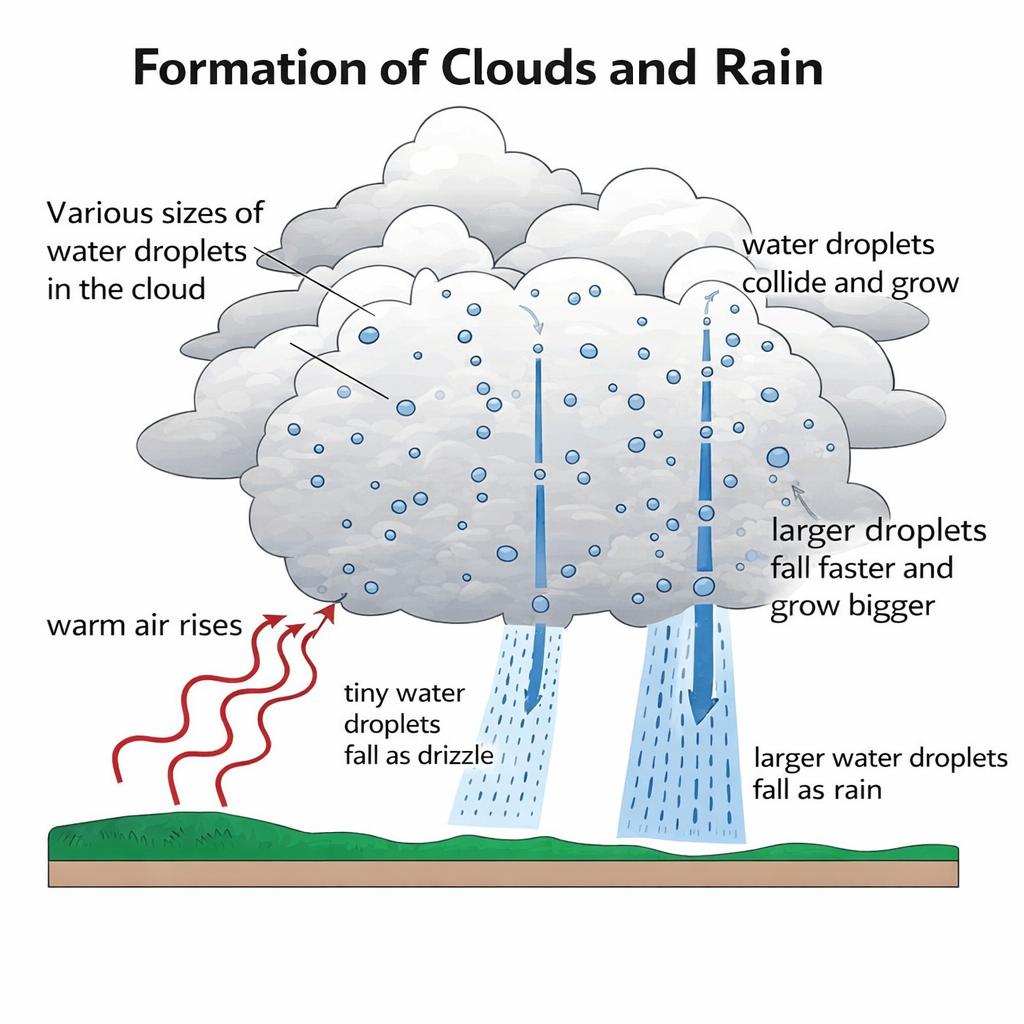
Rain is the result of water’s magical journey. The sun warms the water and causes it to turn into invisible vapor, which rises high into the sky. There, it changes into clouds filled with tiny droplets. When there are too many droplets and they become too heavy, they begin to fall to the ground as rain. Before moving on to the experiment, you can start with a simple conversation with the children.
Teacher: “Children, show me how rain falls!”
Teacher: “And now, what does a cloud look like?” (e.g. the children join their hands above their heads)
Teacher: “And now the sun!” (e.g. the children stretch their arms out wide)
Teacher: “Great! And now a question… where does rain come from?”
Children: “From the clouds!”
Teacher: “And where do the clouds get their water from?”
Teacher: “We’re about to find out in the experiment!”
We invite you to carry out an experiment during which children will learn about how rain forms and about the water cycle in nature.
MATERIALS
- jar
- plate
- ice
- hot water
Instructions
The teacher pours hot water into the jar (up to half its height) and covers it with a plate. Then they set it aside for several seconds until the hot water causes the sides of the jar to fog up. Now the children can place ice cubes on the plate. From that moment, they begin observing the vapor, which quickly condenses and starts to fall downward.
Water behaves the same way in nature. Wherever it falls as rain — whether directly into bodies of water or onto land — it evaporates under the influence of the sun’s rays, forming clouds. Tiny water particles in the clouds collide with one another, increasing their mass, and eventually fall back to the ground as precipitation. We can observe a similar process right here in the jar.
A puddle after rain does not disappear like magic, and it does not soak into the ground right away. It stays on the ground, and we can still see it for some time. When the sun comes out, it warms the water in the puddle. Then some of the water turns into invisible water vapor and rises upward. That is why the puddle gets smaller and smaller until it eventually disappears completely.
Fun Facts
,,Why does rain fall from clouds?”
Clouds contain very tiny droplets of water. At first, they are so light that they float in the air. But over time, they join together and become bigger and heavier. Once they become too heavy, they can no longer “stay” in the cloud and fall to the ground as rain.
,,Do all clouds bring rain?”
No! Not every cloud means rain. Sometimes clouds are small and light, so they simply drift across the sky and nothing falls from them. Rain only appears when a cloud is large, darker, and full of water—then it begins to “release” droplets downward. (If you would like to learn more about clouds, we invite you to read the post “Guess What’s in the Sky?“
“Does rain have a smell?”
Do you sometimes notice a smell after the rain? It is not the rain itself that smells! It is the earth and the plants releasing a scent when water droplets fall on them. That is why the air smells so fresh after rain.
If you would like to explore more water-related activities, we invite you to read our other lesson scenarios.

This post was created as part of the Sustainable Future project, co-financed by the Visegrad Fund.
Related
 TupTupTup content and resources are free and available to everyone — thank you for using them.
If you appreciate what we do, you can support TupTupTup with a donation or by allocating 1.5% of your tax. Simply enter KRS 0000270261 in your tax return, adding the specific purpose: Fundacja To Proste 18808.