


When there’s a storm and a lot of water falls, we call it a downpour.
Downpours are especially dangerous in cities where large areas are covered with concrete – where there are many houses, streets, and cars, but few trees and little soil.
Trees and soil absorb water, and green areas act like a sponge – they hold the water where it falls. But if we cover everything with concrete, paving stones, or new buildings, the sponge disappears. Then the rain starts to flow quickly down roofs and streets into the sewage system and rivers.
Fortunately, downpours in the city usually don’t last long, and after a few hours the situation returns to normal. But even in that short time, a downpour can cause a lot of damage in the city. That’s why we should protect ourselves by planting trees, removing concrete and paving, and building so-called retention basins – natural ponds for storing water.
A good city is one that has many places where rain can naturally soak into the ground. That’s why we must ensure that there are plenty of green areas in the city – such as squares, lawns, pocket parks, green spaces, and even green roofs. In such a city, it will not only be pleasant and green, but also safer – because during heavy rains, the concreted streets won’t turn into rushing streams.
To help children see what the water cycle looks like during a storm, we can conduct a small experiment.
MATERIALS
- A board for writing observations
- Coloured balls in a paper bag (at least 30)
- A lid from a cardboard shoebox
- A small plastic bucket or bowl
- A chair
Task Description
The teacher prepares the room so that there is an empty space in the middle. The children sit in a circle. The teacher announces that the lesson topic will be the water cycle in nature and daily life, and that today they will talk about downpours.
The teacher selects a few volunteers for the experiment.
One of them will be “the water source” – person A, and the other – person B, will be responsible for retaining the right amount of water for specific needs.
Children read the instructions below and act out the scene.
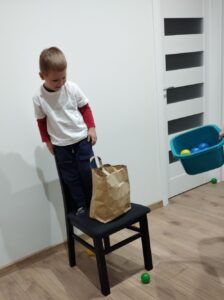
Person A: Stand on the chair. You have all the balls. You must throw them with the force of a downpour – quickly, one after another, or even several at a time.
Person B: Your task is to catch as many balls as possible in the bowl. Remember, you cannot pick them up from the floor. How many balls did you catch? What do you want to use them for? You can discuss your decision with the rest of the class. Write the experiment result on the board.
Write down the conclusions from your observations on the board as well.

This post was created as part of a collaboration between the Veolia Poland Foundation and the CultureLab Foundation under the honorary patronage of the City of Warsaw.