

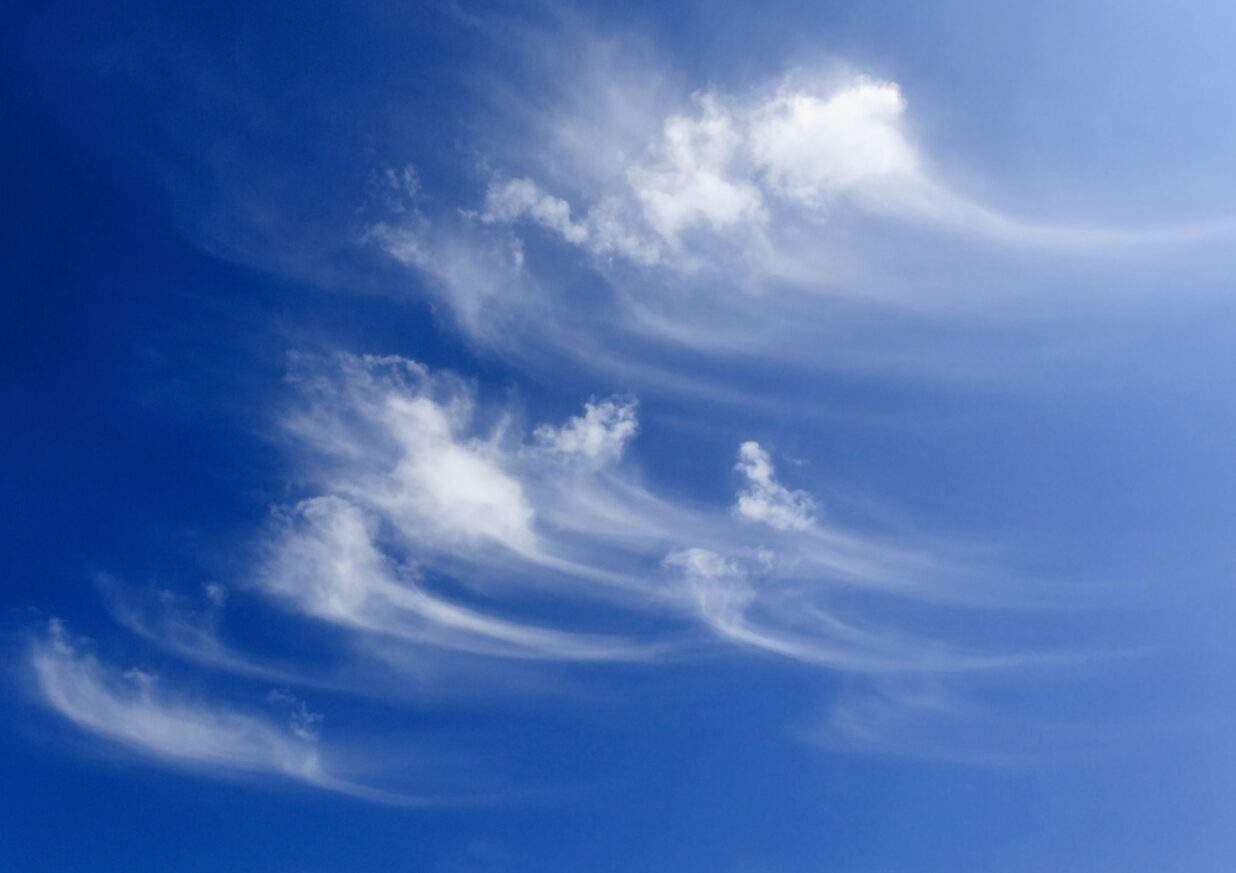
Clouds take many shapes. Sometimes they resemble animals, sometimes people or everyday objects. The sky has fascinated people for centuries, so whenever we have the chance, it is worth looking up and observing what is happening above us. This simple activity not only expands children’s knowledge but also helps them relax and calm down.

MATERIALS
- cloud photos (attachment 2.1)
- paper cutter
Task Description
The teacher downloads the attachment and cuts a window in the center of each sheet. Depending on the number of children, several copies of the sheets can be printed. Next, the group or class goes for a walk and observes the sky through the window in the sheet. By comparing the pictures with what they see in the sky, the children try to identify which type of clouds are present that day.
The slide from the presentation 22.03_World Water Day (slide 6, The Water Cycle in Nature) can be used as an introduction to the activity. Before going for a walk, the teacher shows the slide and explains how the water cycle works and why, even though the amount of freshwater on our planet is limited, water sources are constantly replenished.
The water cycle has no clear beginning, but we can describe it starting from the ocean. The Sun warms the water in the ocean, causing it to evaporate and rise into the air as water vapor. Rising air currents carry the vapor higher into the atmosphere, where lower temperatures cause condensation, which leads to the formation of clouds. Horizontal air currents then move clouds around the globe. Tiny water droplets inside the clouds combine and grow larger until they eventually fall to the ground as rain or snow.
Snow may melt or accumulate on the Earth’s surface in ice sheets and glaciers. Some precipitation flows over the land, reaching rivers and eventually returning to the ocean. Some of the water seeps into the ground or feeds freshwater lakes. Part of the groundwater reaches the Earth’s surface as freshwater springs. Shallow groundwater is absorbed by plant root systems. In plants, water is released through the leaves in a process called transpiration and returns to the atmosphere.
This shows that clouds are an essential part of the water cycle. Without them, water would not be able to circulate around our planet. With older children, the teacher may also explain each type of cloud in more detail.
Depending on the part of the atmosphere in which they form, we can distinguish three cloud levels:
Some theory
LOW LEVEL (up to 2 km):
- Cumulus clouds
These clouds are often seen on warm, sunny summer days. They have clearly defined outlines. Their bases are usually darker, while the tops are brightened by sunlight. They rarely produce rainfall. - Low stratus clouds
These clouds form closest to the Earth’s surface. They create a thick, dark layer that hides the Sun. They are most commonly seen in autumn and winter. - Stratocumulus clouds
They resemble cumulus clouds but are much denser and form large rounded masses that are darker at the base. - Nimbostratus clouds
Dark clouds with a clearly defined base that completely block the Sun. They usually bring long-lasting and steady rainfall.
MIDDLE LEVEL (around 7 km)
- Altostratus clouds
They usually cover the entire sky with a grey or pale blue veil and often create bright halos around the Sun. - Cumulonimbus clouds
Large, dark grey storm clouds shaped like an anvil. Their lower part consists mainly of water droplets, while the upper part contains ice crystals. They bring heavy but short rainfall or hail, often accompanied by thunder and lightning. - Altocumulus clouds
These clouds form flat, rounded clusters. They do not completely block the Sun and usually do not produce precipitation.
HIGH LEVEL (around 13 km)
- Cirrus clouds
They appear as thin, delicate streaks that resemble light feathers. - Cirrocumulus clouds
They form small, feathery clusters that look similar to each other. They are transparent and do not block the Sun. - Cirrostratus clouds
They cover the sky with a thin white veil. Halos around the Sun sometimes appear in these clouds.

This post is funded by the Veolia Foundation and is part of an international project carried out in Polish-German cooperation.

The post is part of the “Kindergarten Calendar”, created within a project co-financed by Deutsche Bundesstiftung Umwelt in cooperation with Naturschutzzentrum Oberlausitzer Bergland.