

The aim of today’s post is to teach children about natural disasters and their impact. The children will also find out the differences between various natural disasters.
MATERIALS
- Printed photos of natural disasters’ outcomes (attachment 1.1)
- Descriptions of natural disasters
Instruction
Sit in a circle with the children. Start the game asking them whether they have heard of any natural disasters. Explain what these are.
Ask if the children can give examples of natural disasters. Maybe they read a book about them or watched a film? Show the children pictures from attachment 1.1. Let them guess which natural disasters they depict. If they have problems with this task, provide them with correct answers.
Begin the guessing game. Read out the descriptions of natural disasters from the following page. The children should try to answer which phenomenon they refer to and find the corresponding photo. Read out every description and show the photos again to consolidate the knowledge. Now the children should be able to name all natural disasters presented in the pictures.
Descriptions of natural disasters
Natural disasters are phenomena caused by the forces of nature (e.g. heavy rain, wind or tectonic movement — the motion of the Earth’s surface). Natural disasters usually result in costly damage in the areas they occur. They tend to have a negative effect on the environment (as they destroy plants and kill many animals) and can be lethal to humans.
Natural disasters include: floods, droughts, wildfires, earthquakes, hurricanes, tornados, avalanches or landslides, volcanic eruptions, severe frosts and heatwaves.
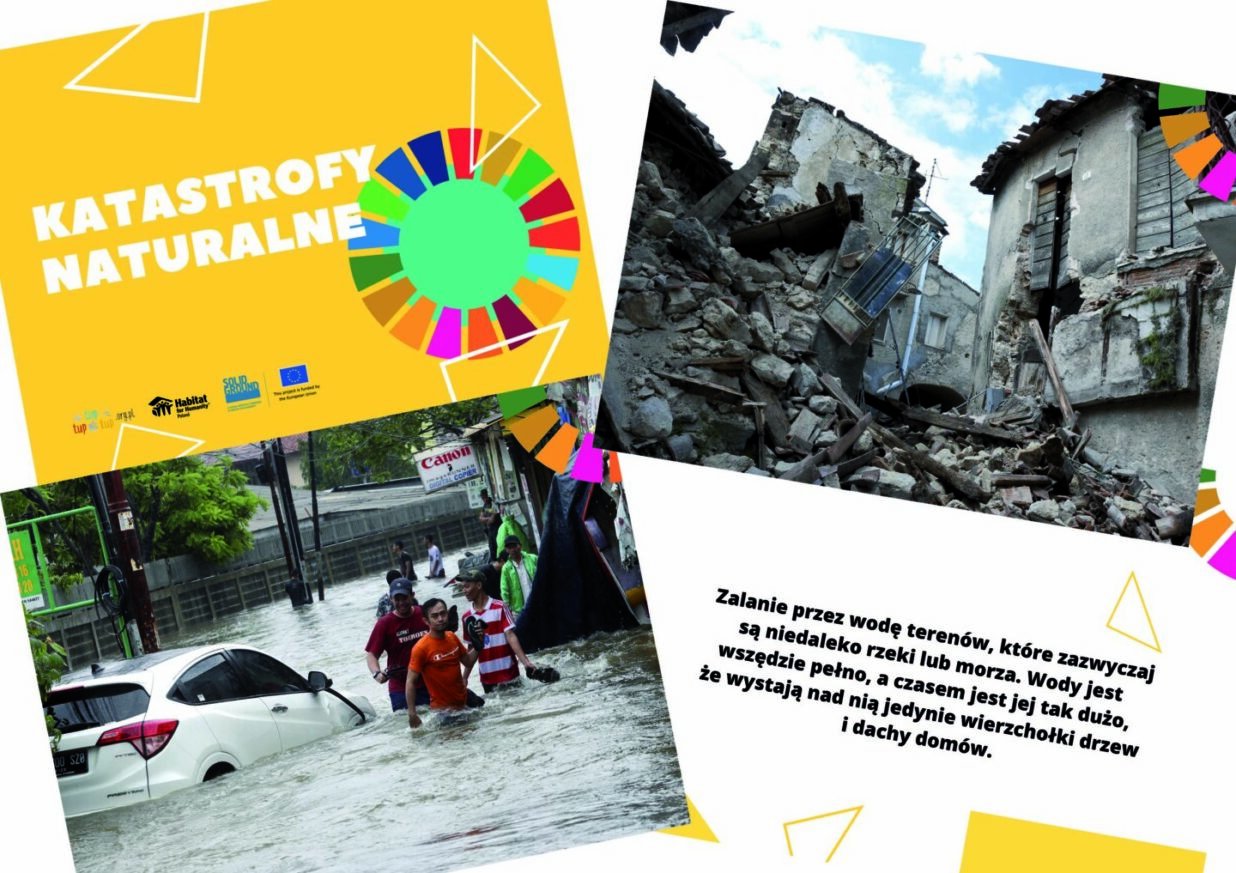
Flood — an overflow of water over the land located close to a river or sea. When it occurs, large amounts of water can cover almost whole buildings and trees.
Earthquake — a quick and sudden tremor that takes its origin from below the ground. Depending on the magnitude of these tremors we can see the objects moving, walls cracking or even whole buildings being destroyed. They may result in earth collapse and the appearance of cracks in the ground.
Hurricane — a very strong wind that frequently causes great damage in the area where it occurs. It originates over the body of water (like seas and oceans) the temperature of which does not exceed 26.5°C. It may reach the land and destroy buildings, pull down electric poles and rip trees off their roots.
Landslide — a sudden collapse of a mass of rocks and mud from a mountain. The mud frequently takes trees on its way and, if it reaches cities, also cars and whole buildings.
Drought — the lack of precipitation which causes the earth to get dry. Such conditions make it extremely hard to cultivate lands and increase the risk of wildfires because the periods of water shortage usually go hand in hand with heat waves.
Volcanic eruption — the event when lava is discharged from under the ground. Magma, which is hot molten rocks, erupts in the form of lava and covers the ground, destroying everything on its path. The magma is accompanied by volcanic ash that can be carried by wind across thousands of kilometres. In some cases the event produces only ash, without magma. The volcanic ash may have a negative impact on people’s and animals’ health and may cause disturbances to air transport.


Project is financed by European Union. This project is a part of global advocacy campaign of Habitat for Humanity aimed at improvement of access to land for a shelter.