


Do you know that snowflakes are just frozen rain droplets? When rain droplets freeze before they fall on the ground, they form into snowflakes. Those flakes have incredible shapes resembling little ice stars.
The rain which hits the ground flows to the sewage system or rivers. Snow doesn’t. If winter is cold for a long period of time, the snow lies on the fields, the pavements or in the garden. Sometimes the winter is so cold that snow lies where it landed for days or weeks. In such a case, it can serve as a great source of fun.
However, snow is needed not only for fun. In our climate it serves a very important purpose – it stores water for spring. When it gets warmer, snow slowly melts and the water soaks into the fields and irrigates them or flows into rivers. Thanks to that, farmers are able to plant plants in spring, for example crops which will grow for the whole summer and will be harvested early fall. Unfortunately, the climate in Poland has been increasingly changing during the last couple of years. Winters are warmer and last shorter and the snow doesn’t lie on the fields until spring. Because of that, the farmers have troubles with spring droughts more often. Furthermore, less snow means smaller snowmen.
The climate is changing. It gets warmer, winters are milder and it’s frosty less often. When our parents were children, it was much colder and there was much more snow. You could sled every day and the snow lay on the fields until April. Nowadays, snow usually falls in January and disappears in February. For the farmers, it may be a serious problem, because if snow doesn’t lie on the fields for the whole winter up until spring and in the spring it doesn’t rain much, then spring droughts occur. Such droughts can stop planted crops from sprouting up or make them sprout later, resulting in the crops being smaller and smaller harvests in fall.
To show little snowfalls to the children, we propose an experiment.
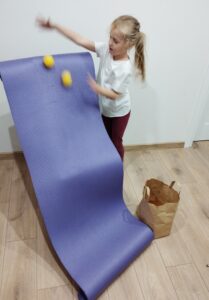
MATERIALS
- Colourful balls (including 3-4 yellow balls and 4-5 red balls)
- Chair
- Carrimat
- Whiteboard to record observations
Task Description
The teacher prepares the classroom so that there is an empty space in the middle of the room. The children sit in a circle. The teacher announces that the topic of the lesson will be snowfalls in winter.
The teacher chooses a couple of volunteers for the experiment.
One of the volunteers will be “the water source” – person A, and the second – person B, will be responsible for stopping an appropriate amount of water for selected needs.
Children read the instructions below and act out the scene.
Person A This year there was really little snow. From the balls put aside all of the blue and green ones. Roll the remaining balls down the carrimat from the chair to the floor. Other children can help hold the rolled-out carrimat.
Person B Using a rope try to stop as many balls as possible. How many balls did you manage to stop? What do you want to use them for? You can consult your decision with the rest of the class. Write the result of the experiment on the whiteboard.
Related

This entry was produced as part of the cooperation between the Veolia Poland Foundation, the CultureLab Foundation under the honorary patronage of the City of Warsaw.