

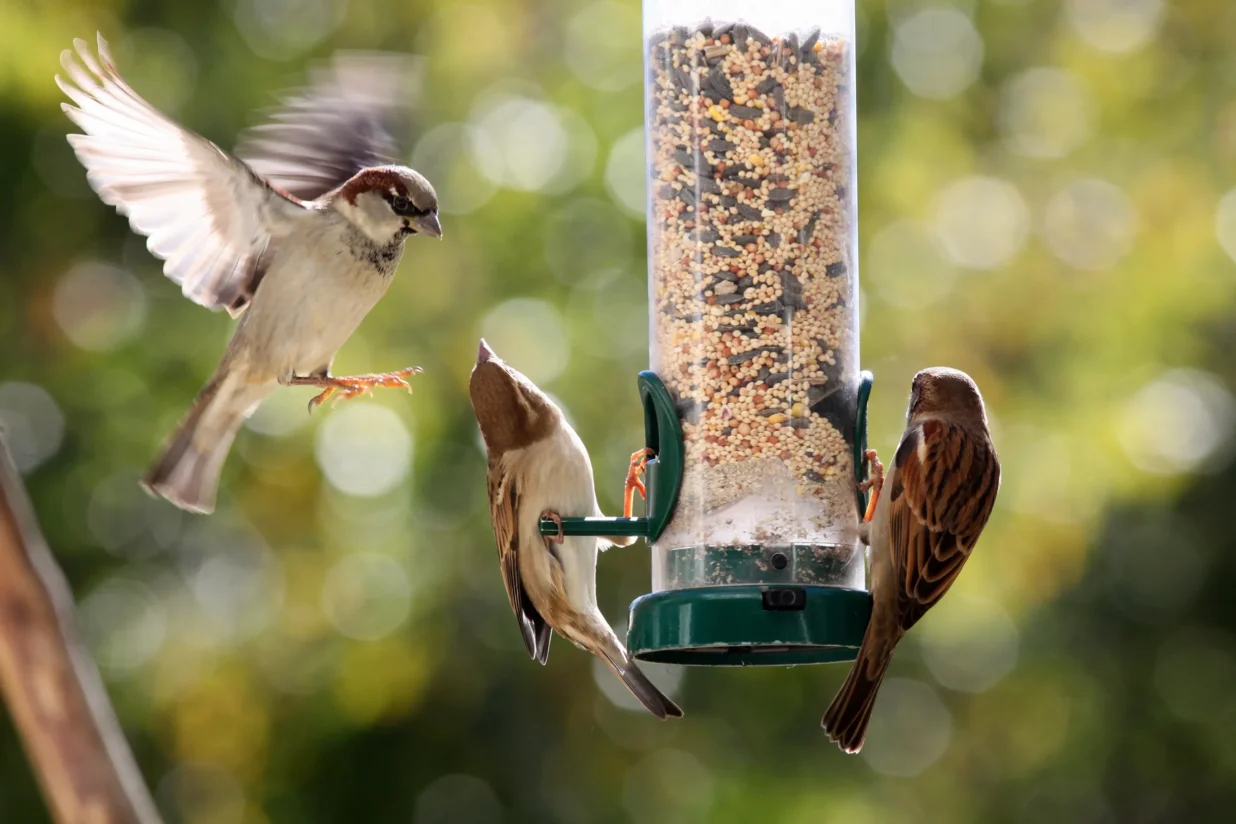
For generations, people around the world have fed backyard birds whatever was handy — table scraps, stale food, leftover bread. However, modern science has put many of these old habits to the test. It turns out that a lot of what we eat is actually harmful to birds. Bread is still a common offering, yet it provides almost no nutritional value. Worse still, it swells up in their stomachs and contains salt, which is toxic to birds. Since salt is found in nearly everything we eat, feeding birds scraps from our own meals is generally a bad idea. It puts strain on their kidneys and forces them to drink more water — something that can be especially hard to find in winter.
Another widespread myth is that spoiled food won’t hurt birds. In fact, mouldy, expired, or fermented food is just as harmful to birds as it is to us.
So what can you feed them? All kinds of grains are a safe choice: wheat, corn, sesame, and oats. Sunflower seeds are a favourite too, even with the shells on. Fruit can also work, but keep in mind that in cold weather it can freeze solid. For that reason, dried fruit is a much better option on frosty days. Birds also enjoy various nuts — walnuts, peanuts, and hazelnuts — but only unsalted and unroasted. One thing that often surprises children: birds can eat suet (raw pork fat). After all, just like among mammals and insects, the bird world has its carnivores too.
In short, it’s worth learning what’s actually safe to put in the bird feeder!
Goal: Help children learn the basic rules of feeding birds.
Time: 25–30 minutes

MATERIALS
- Projector
- Types of food (Attachment 1.1)
- Birds cards (Attachment 1.2)
- Food cards (Attachment 1.3)
- Correct answers (Attachment 1.4)
Activity Steps
- Start by showing children a series of food images on the projector (Attachment 1.1) — foods that are commonly given to birds. Begin with a slide showing question marks and invite children to guess whether each food is safe for birds. After collecting their answers, move to the next slide with the correct answer and briefly discuss it.
- After going through all the slides, clear some space on the floor and lay out the bird cards from printed Attachment 1.2. Spread the birds far apart so children can move around and look at each one freely.
- Hand out the food cards from Attachment 1.3 — each child receives a few at random. Their task is to place each card next to the bird (or birds) they think would eat that food.
- Once all cards have been placed, reveal the correct answers on the projector (Attachment 1.4) and have a short discussion about each bird. It’s worth pointing out that most birds will eat a wide variety of foods, but certain foods are more likely to attract specific species.

This post was created as part of a project co-funded by Deutsche Bundesstiftung Umwelt in collaboration with Naturschutzzentrum Oberlausitzer Bergland.
Related Articles
 TupTupTup content and resources are free and available to everyone — thank you for using them.
If you appreciate what we do, you can support TupTupTup with a donation or by allocating 1.5% of your tax. Simply enter KRS 0000270261 in your tax return, adding the specific purpose: Fundacja To Proste 18808.